Orange County started out in 1824 under another name, Mosquito County. The City of Orlando says that Orlando was the center of the citrus industry in Florida during the 1800s and a center for tourism during the 1900s. Long before that, the Native people of Central Florida lived on the banks of the St. Johns River.
This page tells the story in order, from the first peoples to Animal Kingdom, a soccer championship and Epic Universe, then lists places in the county where you can still see it. The sources for each part are named at the end of that part, and all of them are listed at the bottom of the page.
The first peoples
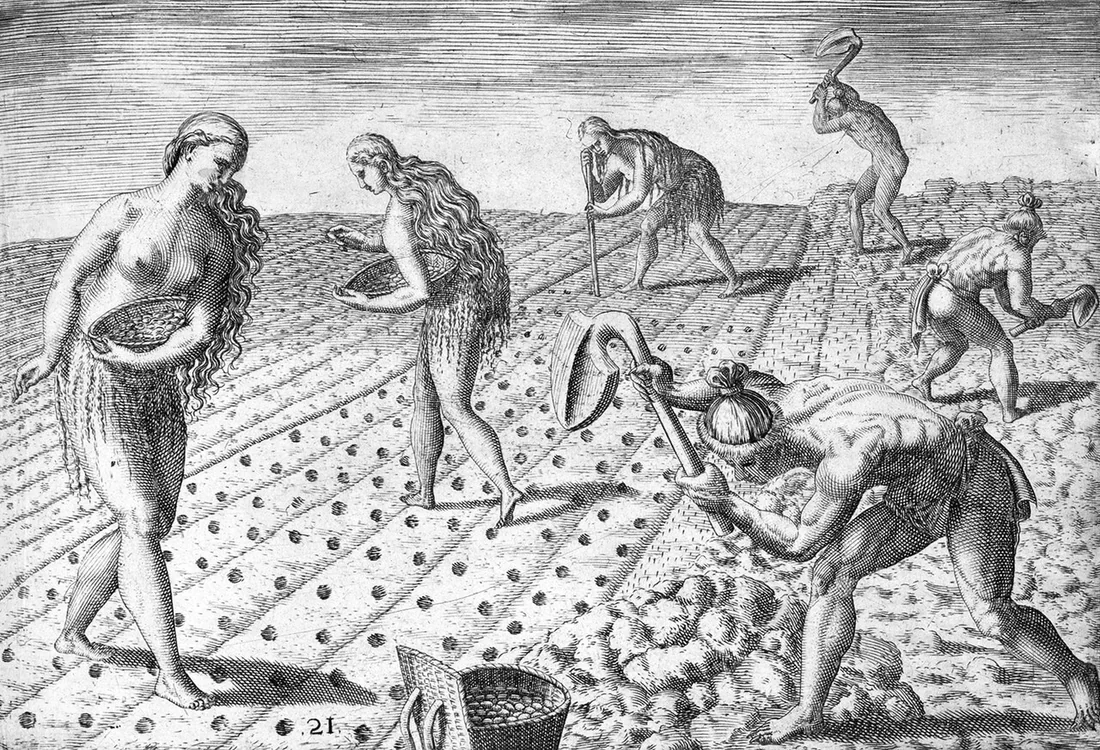
By the time Juan Ponce de León reached Florida, many groups of Native people had lived on the land for a long time. Historians know Central Florida's Native people as the St. Johns people, after the river they lived along. Another name often used for them is the Timucua. The Timucua groups spoke the same language, but they were not united politically. Native people all along the St. Johns made pots of fired clay and used them to cook and store food.
More than 700 white settlers lived in Mosquito County in the 1830s, along with Native tribes, most of them Seminoles. Creeks were the most recent of the Native Americans who lived at Wekiwa Springs, and they later came to be called Seminoles. In the Creek language, the word Wekiwa means "spring of water."
Sources: Orange County Regional History Center: History at Home, Native American Lesson 1, Timucua Pottery Party; Orange County Government: Orange County 200th Anniversary; Florida State Parks: History of Wekiwa Springs
Next: Chapter 2, The Spanish bring citrus and cattle →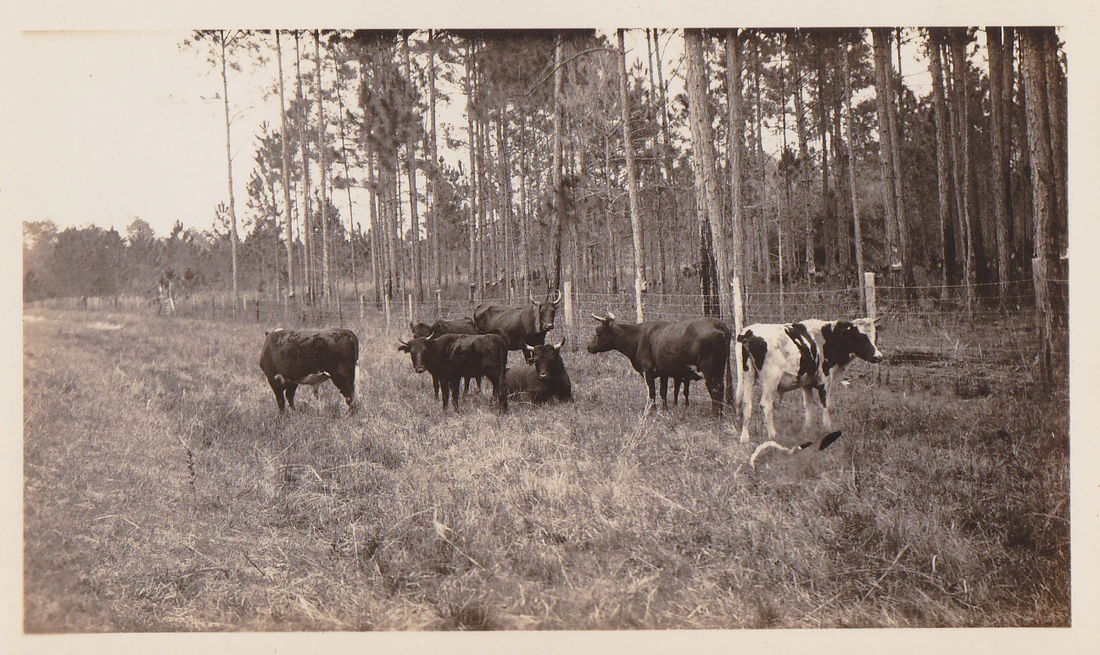
The Spanish bring citrus and cattle
There were no oranges in Florida before the early 1500s, when Spanish explorers arrived carrying citrus. Florida Indians, who got seeds from Spanish missionaries, helped the fruit become established. Cattle and horses were not native here either. They came to North America with Spanish explorers.
Spanish ranchers were shipping cattle to Cuba by the 1600s. For the Seminoles, raising cattle became a way of life from the 1700s on.
Sources: Orange County Regional History Center: Celebrating Hispanic Heritage Month (booklet); Florida Department of State, Division of Historical Resources: The Citrus Industry in Florida
Next: Chapter 3, Mosquito County and the Seminole War →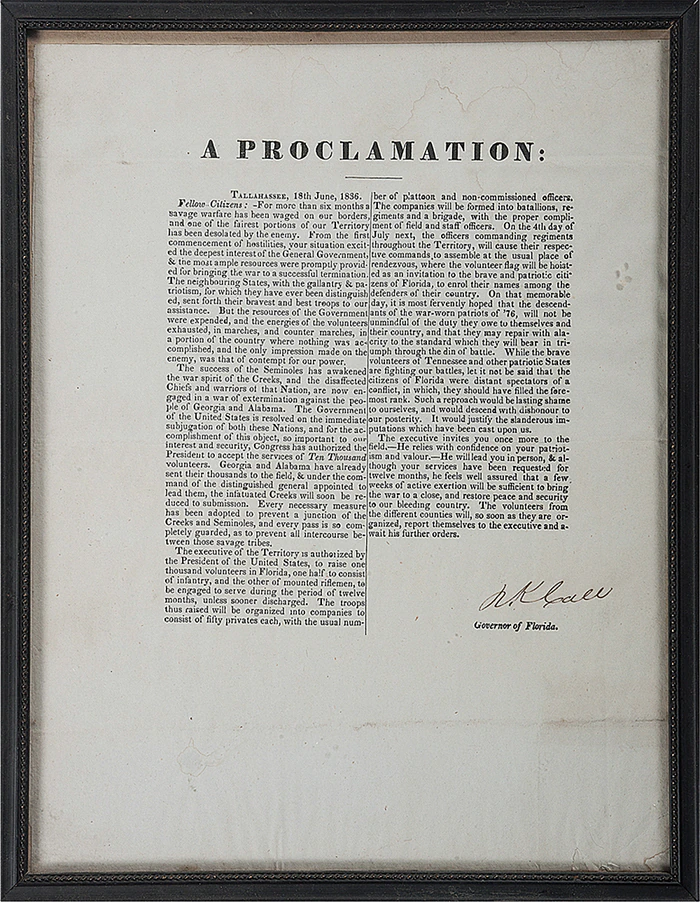
Mosquito County and the Seminole War
Mosquito County was formed in 1824 out of St. Johns County. Sources disagree on the day: the county government says December 29, 1824, and the Orange County Regional History Center says December 24, 1824. Mosquito County also took in land that is now in Seminole, Lake, Osceola, Indian River, Brevard and Volusia counties. The county was named after what the early Spanish called the area's waterways, including Barra de Mosquitos, which means Mosquito Bar or Inlet. At that time, the county had fewer than two people for each square mile.
The goal of the Second Seminole War was to remove the Seminoles from Florida and send them to reservations beyond the Mississippi River, to the west. Troops led by Brigadier General Abraham Eustis started work on Fort Christmas on Christmas Day, 1837. The stockade was a square 100 feet on each side, with walls of upright pine logs 18 feet tall and sharpened at the top. The fort's name came from the date.
The U.S. Army set up Fort Gatlin on November 9, 1838, and named it for John S. Gatlin, an Army assistant surgeon who was killed in 1835 in the Dade Massacre. The site was picked as a military post because it looked out over three lakes and because Native Americans led by King Philip, a Seminole chief, and his son Coacoochee often came to the area. Coacoochee had led the attack on Camp Monroe on February 8, 1837, and days later the camp was renamed for Capt. Charles Mellon, who was killed in the attack. A settlement grew up around the renamed camp and became Mellonville, which the History Center counts among Orange County's first county seats. The Army left Fort Gatlin in 1849, but a few soldiers and families stayed in the area, where they grew citrus and raised cattle.
Sources: Orange County Regional History Center: Reflections, Spring 2020 (From the Director, Michael Perkins); Orange County Government: Orange County 200th Anniversary; Orange County Regional History Center: "Heritage Day" honors founding of Orange County with fun, free admission; Orange County Government Newsroom: History Center Celebrates Day Mosquito County Turned Orange; Orange County Regional History Center: Jim Robison, Reflections, Winter 2013 (Coacoochee); Orange County Regional History Center: In Orange County, we truly have Christmas all year long; Florida Department of State, Florida Historical Markers: Site of Fort Gatlin
Next: Chapter 4, Orange County and the town of Orlando →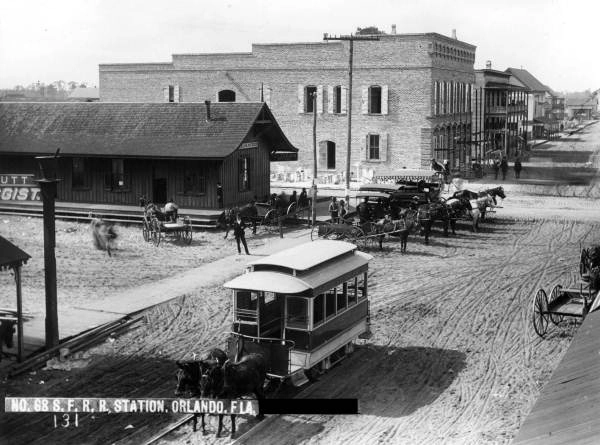
Orange County and the town of Orlando
In 1843, Aaron Jernigan left Georgia for Mosquito County, where he settled on Lake Holden's northwest shore. Mosquito County nearly became Leigh Read County, named for a territorial legislator assassinated in 1842. It came close to being named Harrison County in 1844. Orange was made the official name on January 29, 1845. The county government says the name was picked because of the citrus groves that grew well in the area.
Jernigan won election as the new county's first state legislator. He also put up a blockade in the late 1840s to keep homesteaders safe from Seminole attacks. The settlement around the blockade came to be called the village of Jernigan, which was a forerunner of Orlando. The village's post office was set up on May 30, 1850. The settlement at Fort Gatlin became Orange County's county seat in 1856.
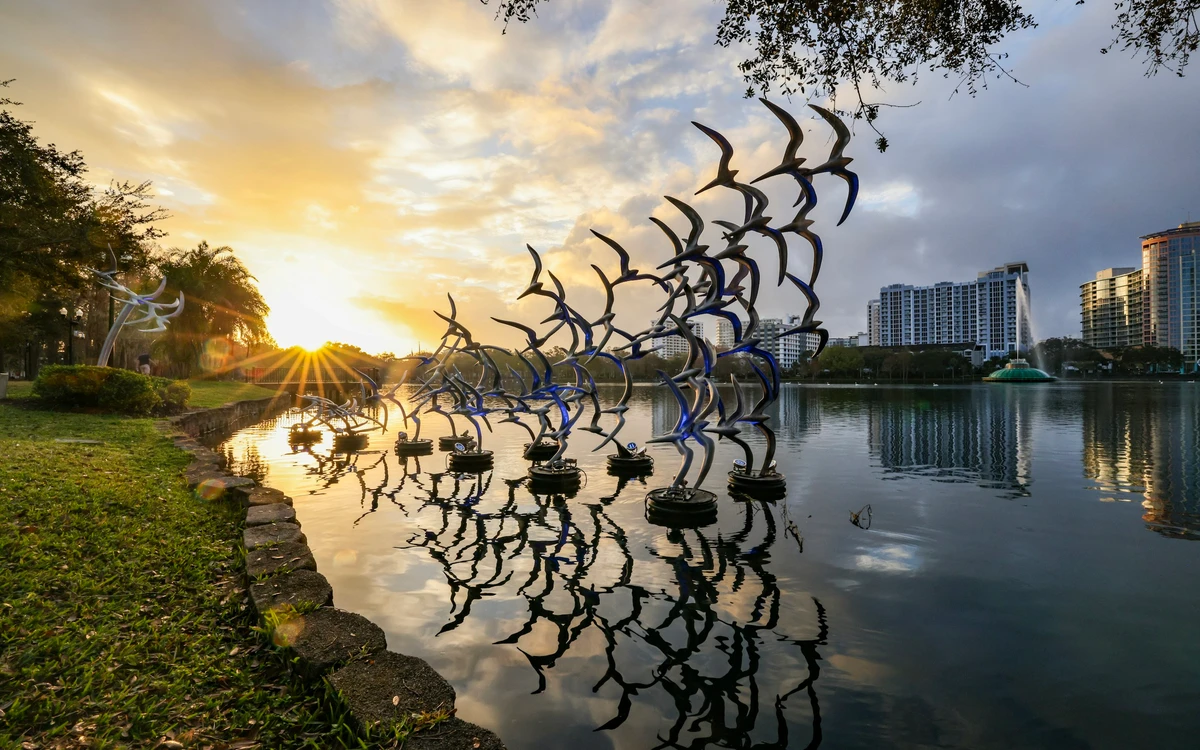
The village of Jernigan took the name Orlando, and the U.S. Post Office began using it in 1857. The City of Orlando says the origin of its name is not certain. One story says the name honors a man who had once worked for the person who picked it. In another, Orlando Reeves was killed by arrows when Indians attacked a camp, and he was buried on Lake Eola's south side. The state historical marker at Fort Gatlin also ties the name to Orlando Reeves, but it says he is thought to be buried near where Fort Gatlin stood.
Sources: Orange County Government: Orange County 200th Anniversary; Orange County Regional History Center: Reflections, Spring 2020 (From the Director, Michael Perkins); Orange County Regional History Center: "Heritage Day" honors founding of Orange County with fun, free admission; City of Orlando: Orlando History; Florida Department of State, Florida Historical Markers: Site of Fort Gatlin
Next: Chapter 5, Orlando, the railroad and Winter Park →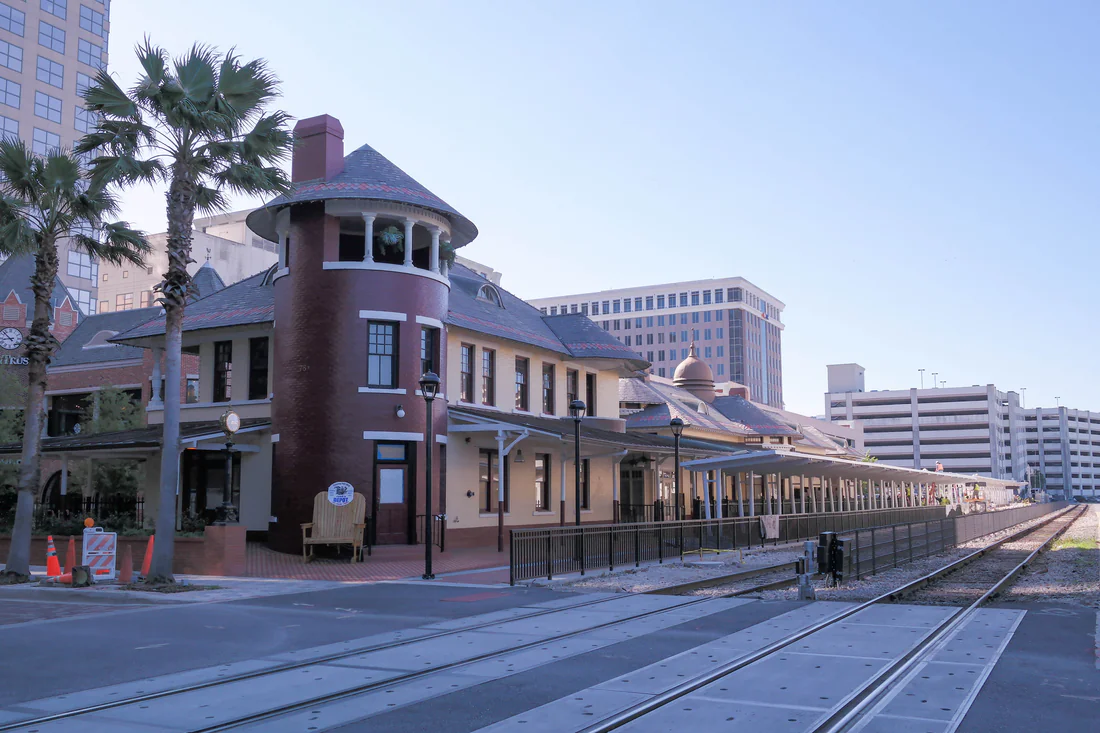
Orlando, the railroad and Winter Park
On July 31, 1875, Orlando was incorporated as a town. It had 85 residents, and 22 of them were qualified voters. In 1885, Orlando became a city.
The City of Winter Park says the South Florida Railroad was the first railroad in Orange County. Henry Shelton Sanford backed it, and African American workers built it. The line ran 23 miles between Sanford and Orlando and opened in 1880. In 1883, Henry Plant bought the line and added it to his Plant System. In 1889, a brick depot, later known as Church Street Station, replaced Orlando's first station, a small wooden building.
In 1881, Loring Chase and Oliver Chapman, who had been boyhood friends in Massachusetts, bought 600 acres in what became Winter Park. Their plan included a Black neighborhood for grove workers and domestic servants. In 1885, the Florida Congregational Association picked Winter Park for Rollins College, and the college's first term started that November. In October 1887, Winter Park became an incorporated town. In the 1880s, the Orange Belt Railroad came to Winter Garden.
Sources: Orange County Government: Orange County 200th Anniversary; City of Orlando: Orlando History; City of Winter Park: History; University of Central Florida, RICHES: Church Street Station/Old Orlando Railroad Depot
Next: Chapter 6, Eatonville and Hannibal Square →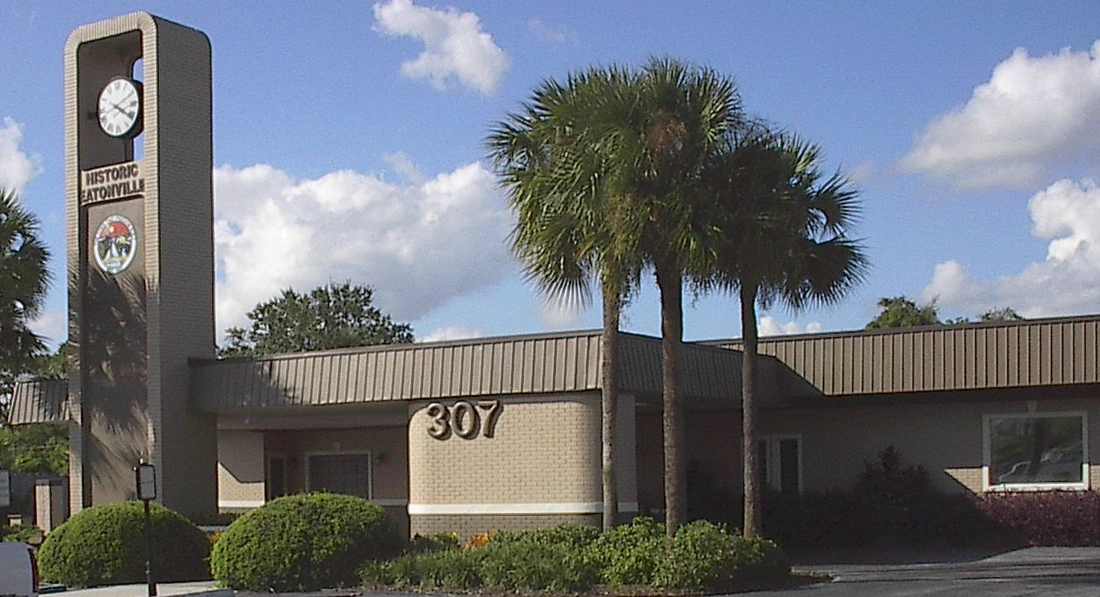
Eatonville and Hannibal Square
Eatonville was first settled in 1880 by people newly freed from slavery, who had come from Georgia, Alabama and farther north. Joe Clarke and others obtained 112 acres with help from Josiah Eaton, a landowner in the area, and Lewis Lawrence, a philanthropist from the North. It was Lawrence who proposed naming the town after Eaton. Columbus H. Boger was elected mayor on August 15, 1887, by 27 voters who met at the "town hall." A state historical marker spells Clarke's name Joseph Clark and calls him Eatonville's founder and first mayor, so sources disagree on who was mayor first.
By the town's own account, it was the first town in the country that African American citizens organized, governed and incorporated. The county government says Eatonville is known nationally as the oldest U.S. municipality incorporated by Black citizens. The writer Zora Neale Hurston portrayed the town in Their Eyes Were Watching God, her novel from 1937. Tillie Moseley, a niece of Joe Clarke, was her best friend, and when Hurston came back to town she often stayed at the Moseley home. The Moseley House dates from about 1888.
In 1893, Winter Park residents circulated a petition to redraw the town's boundaries. They wanted to cut out the Hannibal Square area, where most residents were Black. They could not convince the Town Council. But the Legislature approved their plan. A large part of the west side stayed outside the town until 1925, when a new charter was adopted.
Sources: Town of Eatonville: About Eatonville; Florida Department of State, Florida Historical Markers: Moseley House; Orange County Government: Orange County 200th Anniversary; City of Winter Park: History
Next: Chapter 7, The Great Freeze of 1894 and 1895 →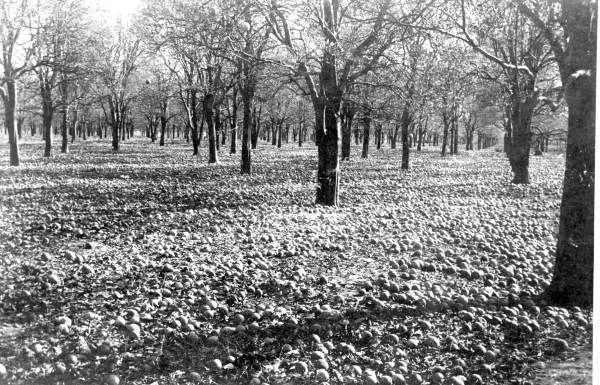
The Great Freeze of 1894 and 1895
By December 29, 1894, a heavy rainstorm had blown in, and Orlando's temperature had dropped to 18 degrees or lower. A second freeze followed on February 7, 1895. The fruit died in the December freeze, and the trees died in the February one. Growers then reported that their 21,737 acres of citrus had not produced a single box.
The damage to the economy lasted more than ten years. A new tree took seven years to bear fruit, and few small growers could afford to wait that long. As a result, large growers ended up in control of the citrus business. When the citrus belt moved south, Polk, Lake and Orange counties became the main places where citrus was grown. Florida's citrus production was back at its 1894 level by 1909.
Groves covering thousands of acres surrounded Orlando in the 1920s. In downtown Orlando, twelve large packing houses stood along the railroad. Over half of the citrus Florida grew each year went through Orlando before reaching market. The county government says Winter Garden was at one time among the largest centers in the world for growing, processing and shipping citrus.
Sources: Orange County Regional History Center: The Great Freeze of 1894-1895; Florida Department of State, Division of Historical Resources: The Citrus Industry in Florida; Orange County Government: Orange County 200th Anniversary
Next: Chapter 8, Election Day in Ocoee, 1920 →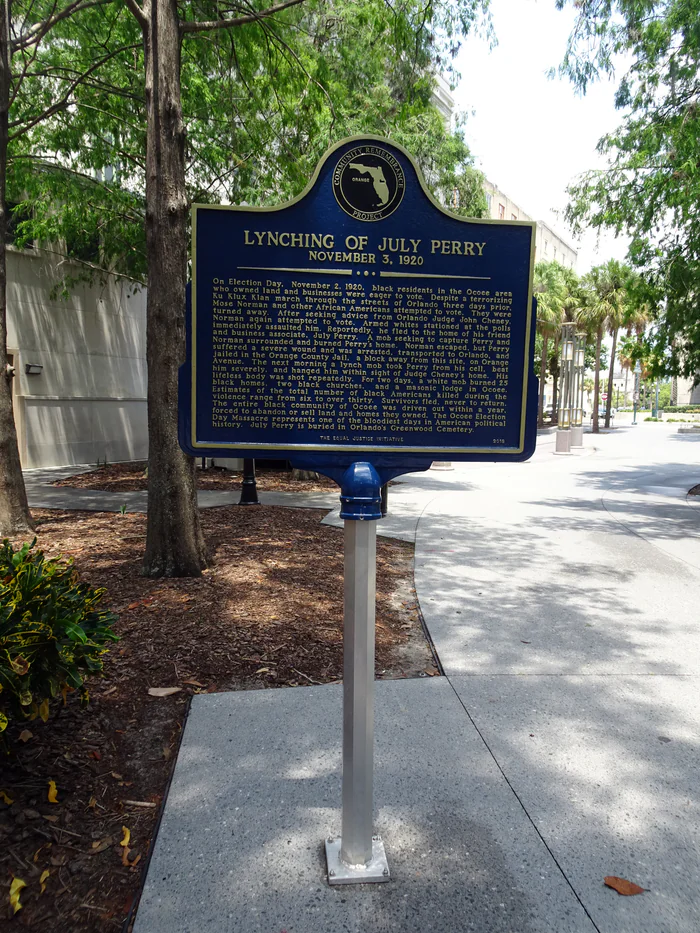
Election Day in Ocoee, 1920
Before the election of 1920, the United Confederate Veterans and the Ku Klux Klan staged rallies and parades to deter African Americans from voting. County officials arranged to have the local notary public away from town, so no one could legally confirm that a voter had paid the poll tax. On Election Day, November 2, 1920, African Americans were the only voters challenged to show they had paid the poll tax. When an African American man named Mose Norman tried to vote in Ocoee, he was not allowed into the polling place. Norman left and came back later, and this time he was beaten and forced away.
A group of armed white citizens then went to the house of a well-known African American businessman, Julius "July" Perry. In the gunfight that followed, two white men were killed and Perry was seriously wounded. Perry was held in Orlando at the Orange County Jail, but a white mob got him out and lynched him close to Judge John M. Cheney's home. The Ocoee area had two African American communities, and on November 3, 1920, a white mob, reported to number at least 100 people, went into one of them, Northern Quarters. The mob burned homes, churches, schools, businesses and a lodge that belonged to or served African Americans.
Those who tried to flee the burning buildings were shot. No one knows how many Black residents were killed, and the deaths were not recorded. Going by the 1920 census, 495 African American residents were forced out of Ocoee. Local authorities seized the property they left behind and split it up among the white residents. The City of Ocoee formally apologized to families in 2020, at a ceremony where a historical marker was unveiled.
Sources: Florida Department of State, Florida Historical Markers: Orange County Election Day Violence/Ocoee Massacre and Exodus; FOX 35 Orlando: Historic marker unveiled remembering Ocoee Massacre; Orange County Regional History Center: Yesterday, This Was Home: The Ocoee Massacre of 1920
Next: Chapter 9, A courthouse, a war and new industry →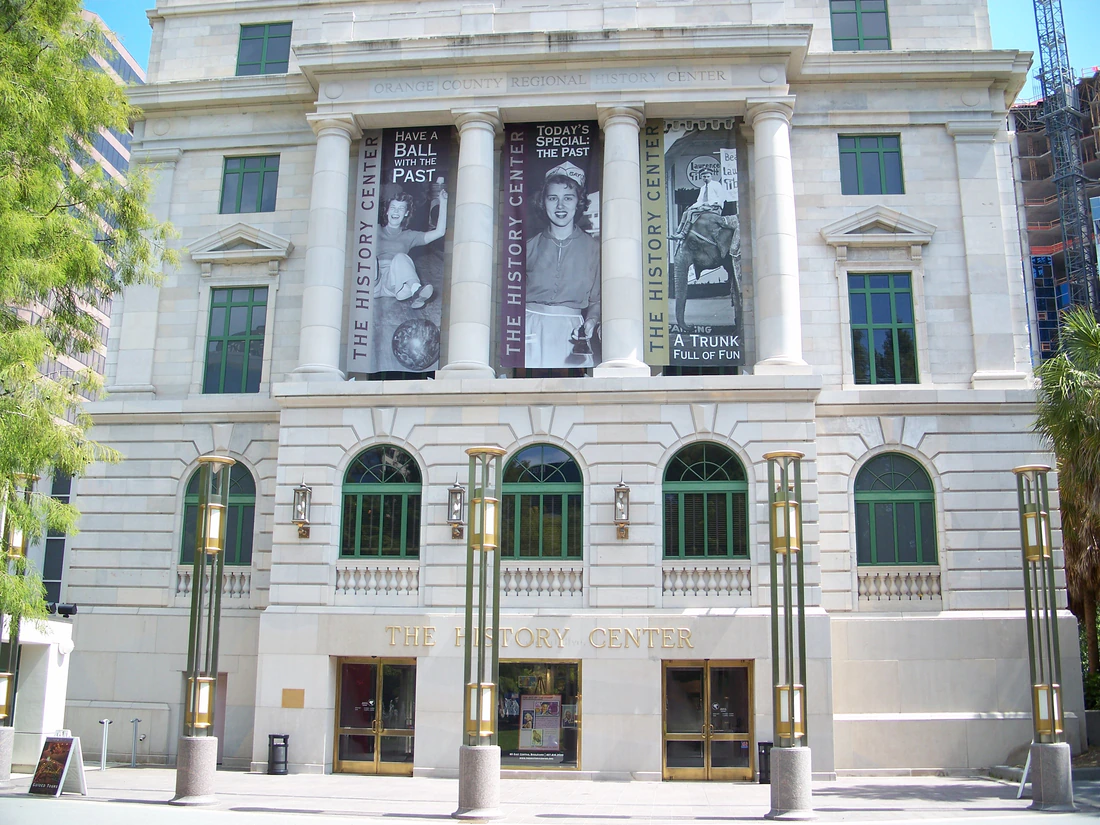
A courthouse, a war and new industry
Wilbur and Rose Warren gave eight acres in 1924 for what the county government says was its first public park. In 1927, the county got a new building in the neoclassical revival style, and it became the main courthouse. That building is now home to the Orange County Regional History Center, which opened in September 2000.
In 1941, the U.S. Navy set up the Underwater Sound Reference Laboratory on Lake Gem Mary, near the site of Fort Gatlin. During World War II, chemical munitions and B-17 bombers were tested at the Pine Castle base. In 1942, Jeannette Genius started the Morse Gallery of Art at Rollins College. The gallery's name came from her grandfather, Charles Hosmer Morse, an industrialist and philanthropist. On May 20, 1987, the gallery took a new name, the Charles Hosmer Morse Museum of American Art.
The Glenn L. Martin Company, which made aircraft and aerospace products, set up its Orlando office in 1956. The Orlando office served as main contractor on the Pershing missile for the U.S. Army. The Pine Castle base became McCoy Air Force Base in 1958. The new name came after a wing failed on Colonel Michael Norman Wright McCoy's plane and he crashed it at the base to avoid a residential area. The first part of Interstate 4 opened to traffic in 1959.
Sources: Orange County Government: Orange County 200th Anniversary; Orange County Regional History Center: The Story of the History Center; Florida Department of State, Florida Historical Markers: Site of Fort Gatlin; Charles Hosmer Morse Museum of American Art: Museum Timeline
Next: Chapter 10, Walt Disney World and the theme parks →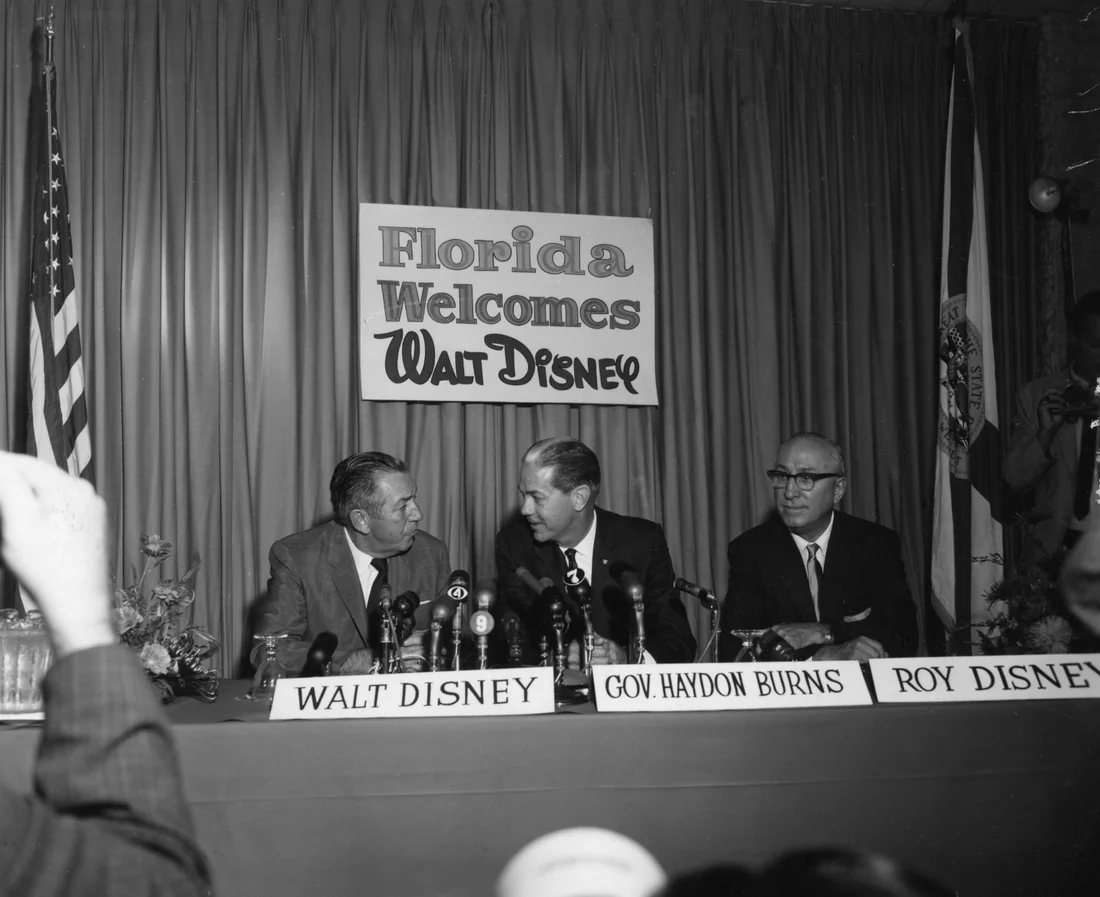
Walt Disney World and the theme parks
By mid-1965, Disney had paid a little more than five million dollars for over 27,000 acres. The purchases were made through nine front companies. Walt Disney and Roy O. Disney, his brother, announced their plans for the Florida project at a press conference in downtown Orlando on November 15, 1965. Governor Haydon Burns said it was the most significant day in Florida's history. In a film made on October 27, 1966, Walt Disney said the property was between Orlando and Kissimmee, with part in Orange County and part in Osceola County.
On December 15, 1966, Walt Disney died. Leadership of the Florida project passed to his brother Roy. The Reedy Creek Improvement District was created by a law that Governor Claude Kirk signed on May 12, 1967. On October 1, 1971, Walt Disney World opened, starting out with the Magic Kingdom theme park and two hotels.
SeaWorld Orlando opened on December 15, 1973, under the name SeaWorld of Florida. On June 7, 1990, Universal Studios Florida opened.
Sources: Florida Memory: When Disney Came to Florida; FOX 35 Orlando: The history of Walt Disney World and its opening 50 years ago; Orange County Government: Orange County 200th Anniversary
Next: Chapter 11, Since 1990: Animal Kingdom, a soccer championship and Epic Universe →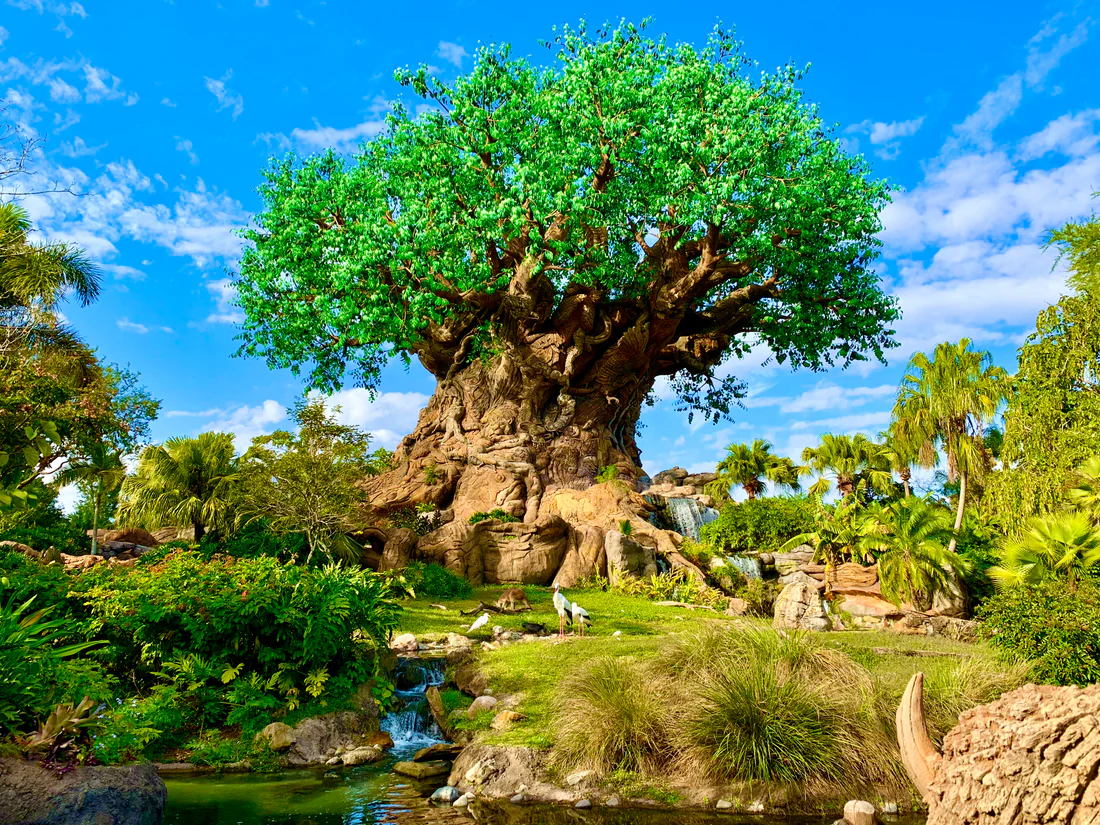
Since 1990: Animal Kingdom, a soccer championship and Epic Universe
Disney's Animal Kingdom opened on April 22, 1998, which was Earth Day. Its landmark is the Tree of Life, with 337 animal figures sculpted into its trunk. On September 29, 2000, the Orange County Regional History Center opened in the 1927 courthouse after the building was restored and renovated. On August 13, 2004, Hurricane Charley came ashore on Florida's southwest coast. That night its center passed close to Kissimmee and Orlando.
SunRail service opened to the public on May 1, 2014, on a 32-mile line with 12 stations between DeBary and south Orlando. MetroPlan Orlando called it the region's first commuter rail service. On November 6, 2014, the Dr. Phillips Center for the Performing Arts held its grand opening in downtown Orlando. Brightline began running trains between Orlando and Miami on September 22, 2023. Its Orlando station is inside Terminal C at Orlando International Airport.
On November 23, 2024, the Orlando Pride beat the Washington Spirit 1-0 in Kansas City to win the National Women's Soccer League championship. The club calls it the first major league trophy won by a professional team from Orlando. Two days later, the team rode trolley cars down Orange Avenue in a parade with Mickey and Minnie Mouse. On May 22, 2025, Universal opened Epic Universe, which joined Universal Studios Florida, Islands of Adventure and the Volcano Bay water park. NBC Miami called it Florida's first major, traditional theme park since 1999, the year Islands of Adventure opened.
Sources: WFTV Channel 9: Disney’s Animal Kingdom celebrates 25th anniversary on Earth Day; Walt Disney World News (Disney press release): Disney’s Animal Kingdom Theme Park Celebrates 25 Years Showcasing the Magic of Nature; Orange County Regional History Center: History Center Marks 25 Years in Historic Downtown Courthouse; National Hurricane Center: Tropical Cyclone Report, Hurricane Charley, August 9-14, 2004; Spectrum News 13: SunRail trains reach capacity, run late on first days of service; MetroPlan Orlando: ALL Aboard for the Opening Day of SunRail's Commuter Train Service; Orange County Government Newsroom: Orange County Celebrates Dr. Phillips Center’s First Anniversary; Orange County Government Newsroom: Orange County Celebrates the Dr. Phillips Center for the Performing Arts Grand Opening; WKMG News 6: Brightline launches high-speed rail in Florida, connecting Orlando to Miami; Orlando Pride: Match Report: Orlando Pride win 2024 NWSL Championship, bringing first professional major league trophy to the City of Orlando; Spectrum Bay News 9: Orlando celebrates Pride with parade, festivities for winning NWSL championship (Nov. 25, 2024); FOX 35 Orlando: Epic Universe is now open in Florida; NBC Miami: Universal Epic Universe opens May 22: What to know about attractions, pricing and more
Next: the whole story, in dates →The whole story, in dates
Central Florida's Native people live beside the St. Johns River.
Citrus arrives in Florida with Spanish explorers.
Spanish ranchers ship cattle to Cuba.
The Seminoles make raising cattle a way of life.
Mosquito County is formed out of St. Johns County.
Camp Monroe is attacked, with Coacoochee leading.
Work starts on Fort Christmas.
Fort Gatlin is set up by the Army.
Aaron Jernigan makes his home on Lake Holden.
Orange becomes the county's official name.
The village of Jernigan gets a post office.
Fort Gatlin's settlement is made the county seat.
The U.S. Post Office starts using the name Orlando.
Orlando becomes an incorporated town.
People newly freed from slavery settle Eatonville.
Trains start running between Sanford and Orlando on the South Florida Railroad.
Loring Chase and Oliver Chapman buy 600 acres in the future Winter Park.
Orlando is made a city.
Twenty-seven voters in Eatonville choose a mayor.
A brick depot takes the place of Orlando's wooden station.
Winter Park residents petition to redraw the town limits and leave out Hannibal Square.
A freeze brings Orlando down to 18 degrees or colder.
Another freeze kills the citrus trees.
Violence starts in Ocoee on Election Day.
The county gets a new main courthouse building.
The Glenn L. Martin Company comes to Orlando.
Walt and Roy O. Disney reveal their Florida project in Orlando.
Walt Disney World opens to visitors.
SeaWorld opens under the name SeaWorld of Florida.
Universal Studios Florida opens to visitors.
Disney's Animal Kingdom opens on Earth Day.
The History Center opens in the restored 1927 courthouse.
Hurricane Charley comes ashore and its center passes near Orlando that night.
SunRail service opens to the public.
The Dr. Phillips Center for the Performing Arts holds its grand opening.
Brightline begins running trains between Orlando and Miami.
The Orlando Pride win the National Women's Soccer League championship.
Universal opens Epic Universe.
Where you can still see it
 01
01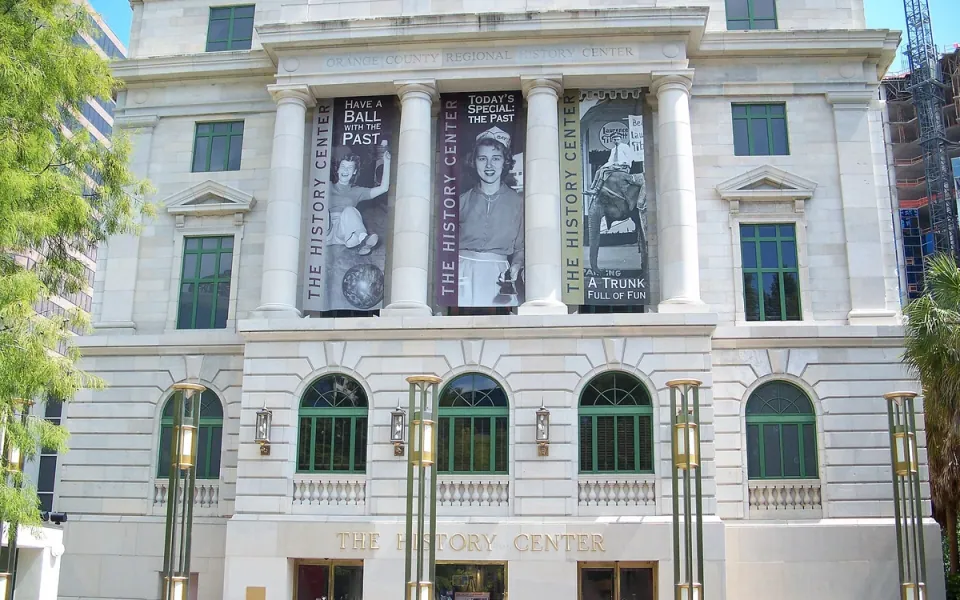 02
02Orange County Regional History Center
Goes with: A courthouse, a war and new industry
Open the place page →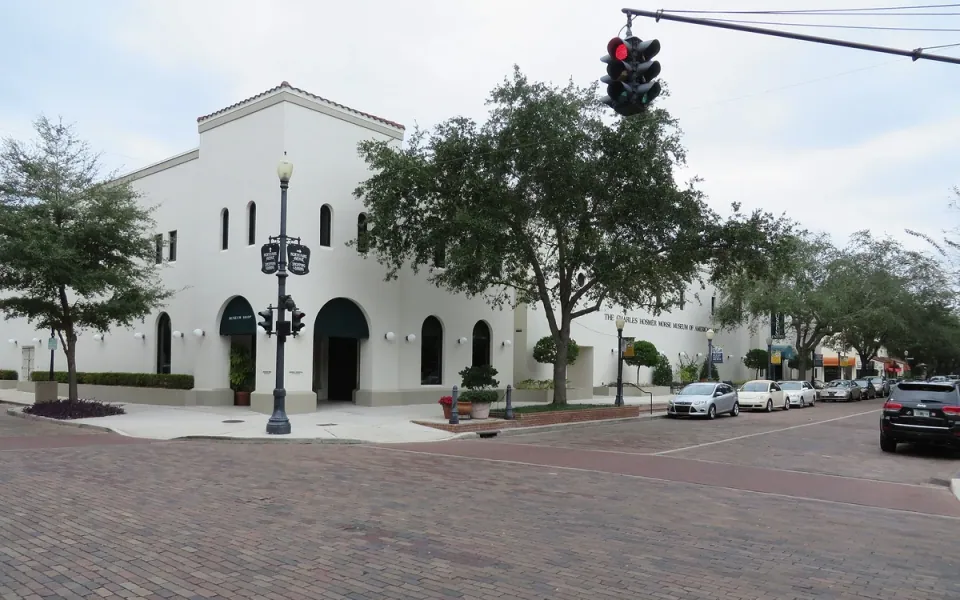 03
03Charles Hosmer Morse Museum of American Art
Goes with: A courthouse, a war and new industry
Open the place page →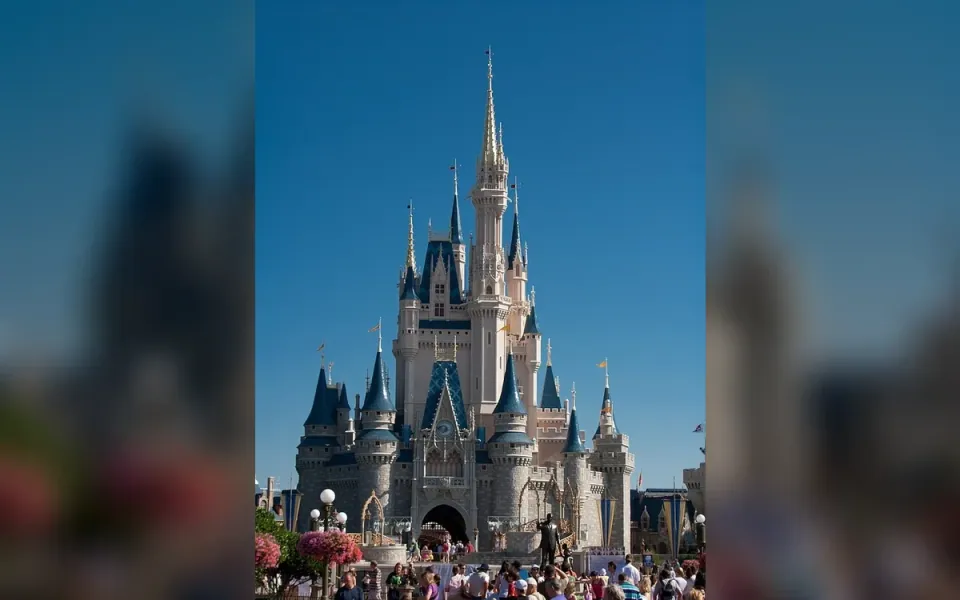 04
04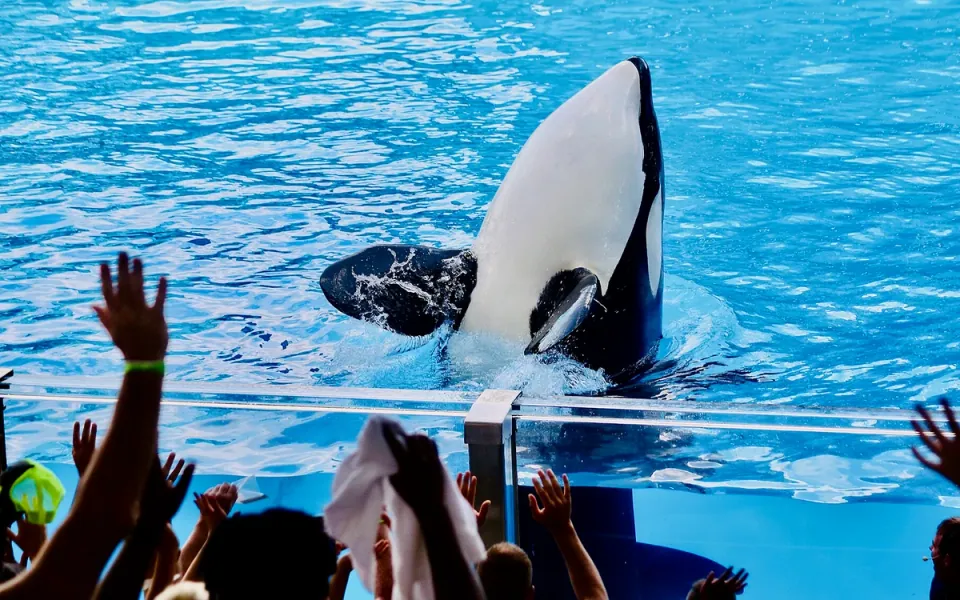 05
05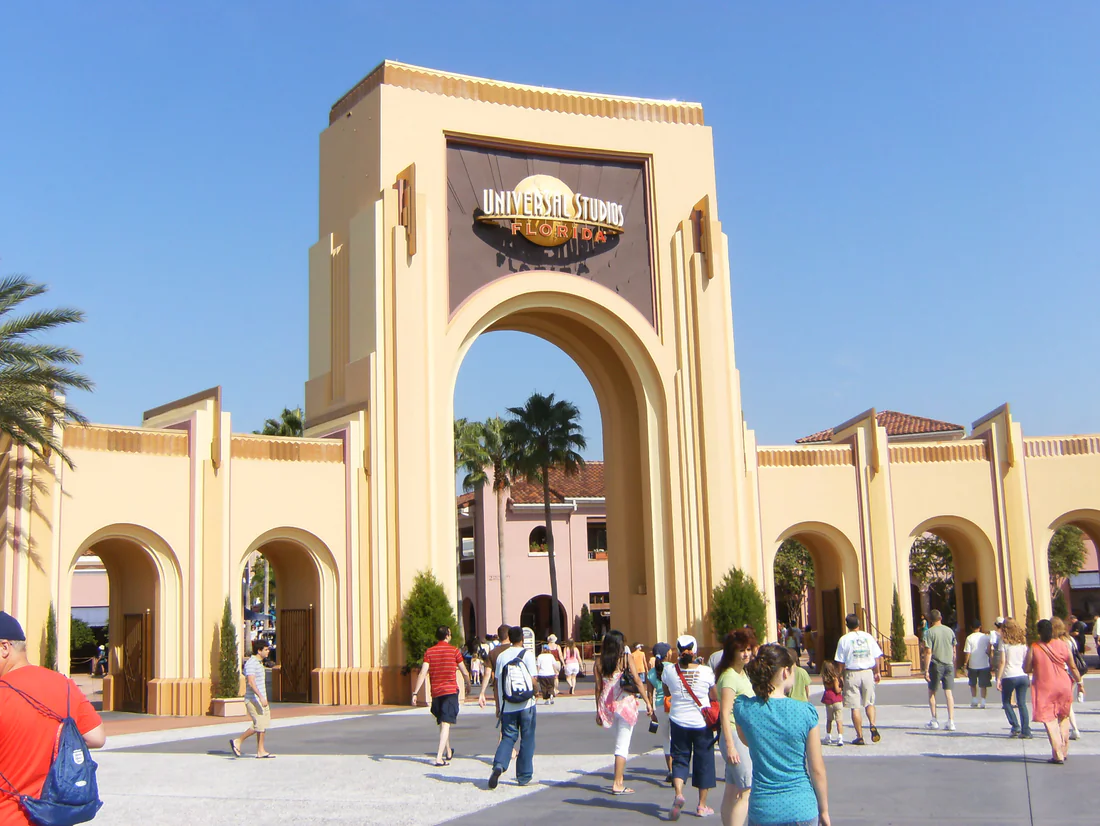 06
06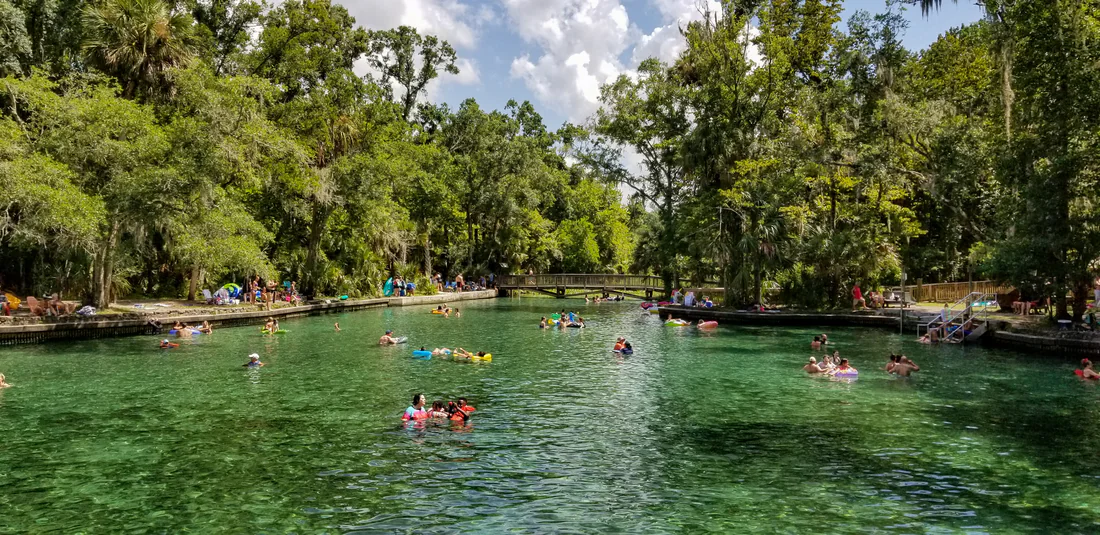 07
07Wekiwa Springs State Park
Goes with: The first peoples
Wekiwa Springs State Park on the Florida State Parks site →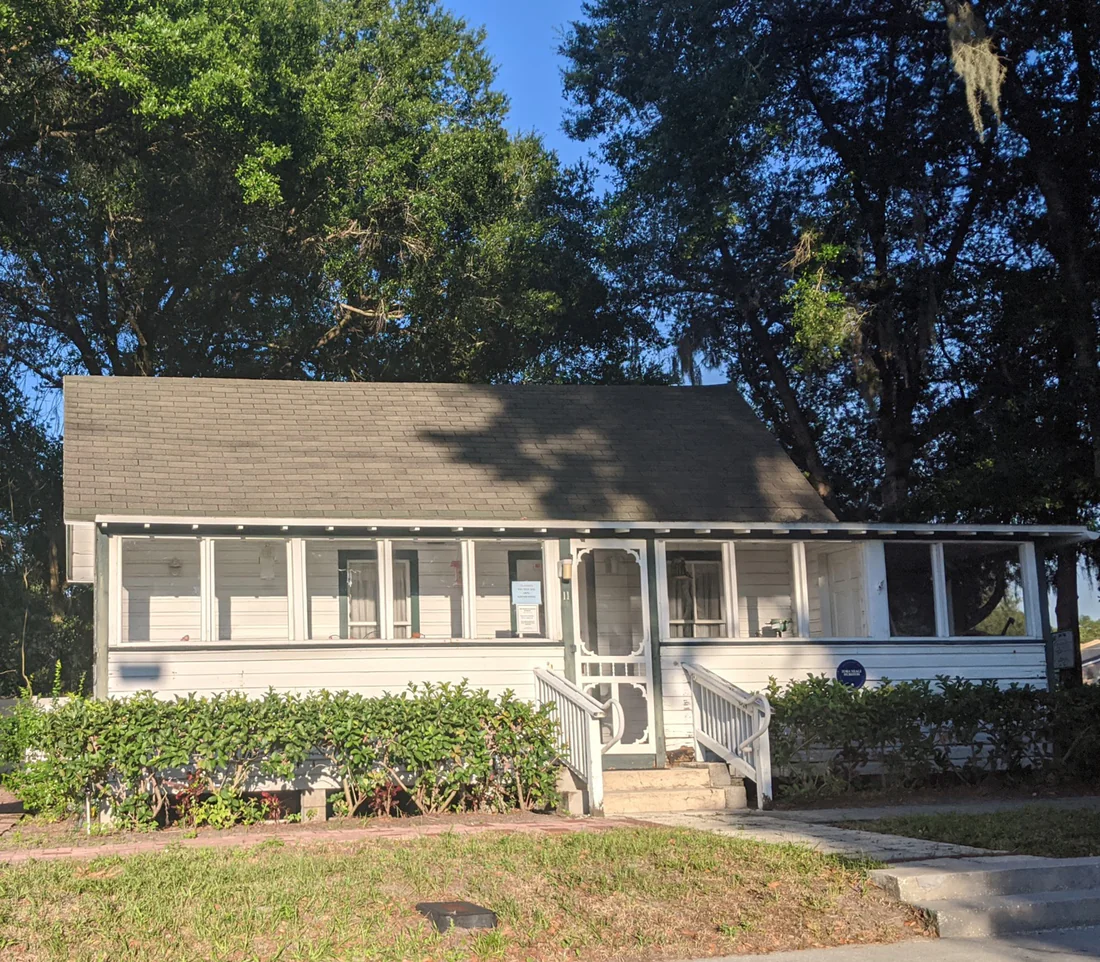 08
08Moseley House, Eatonville
Goes with: Eatonville and Hannibal Square
the state historical marker for the Moseley House →Where this comes from.
- Orange County Government: Orange County 200th Anniversary ↗ Read October 15, 2026
- City of Orlando: Orlando History ↗ Read October 15, 2026
- Orange County Regional History Center: History at Home, Native American Lesson 1, Timucua Pottery Party ↗ Read October 15, 2026
- Florida State Parks: History of Wekiwa Springs ↗ Read October 15, 2026
- Orange County Regional History Center: Celebrating Hispanic Heritage Month (booklet) ↗ Read October 15, 2026
- Florida Department of State, Division of Historical Resources: The Citrus Industry in Florida ↗ Read October 15, 2026
- Orange County Regional History Center: Reflections, Spring 2020 (From the Director, Michael Perkins) ↗ Read October 15, 2026
- Orange County Regional History Center: "Heritage Day" honors founding of Orange County with fun, free admission ↗ Read October 15, 2026
- Orange County Government Newsroom: History Center Celebrates Day Mosquito County Turned Orange ↗ Read October 15, 2026
- Orange County Regional History Center: Jim Robison, Reflections, Winter 2013 (Coacoochee) ↗ Read October 15, 2026
- Orange County Regional History Center: In Orange County, we truly have Christmas all year long ↗ Read October 15, 2026
- Florida Department of State, Florida Historical Markers: Site of Fort Gatlin ↗ Read October 15, 2026
- University of Central Florida, RICHES: Church Street Station/Old Orlando Railroad Depot ↗ Read October 15, 2026
- City of Winter Park: History ↗ Read October 15, 2026
- Town of Eatonville: About Eatonville ↗ Read October 15, 2026
- Florida Department of State, Florida Historical Markers: Moseley House ↗ Read October 15, 2026
- Orange County Regional History Center: The Great Freeze of 1894-1895 ↗ Read October 15, 2026
- Florida Department of State, Florida Historical Markers: Orange County Election Day Violence/Ocoee Massacre and Exodus ↗ Read October 15, 2026
- Orange County Regional History Center: Yesterday, This Was Home: The Ocoee Massacre of 1920 ↗ Read October 15, 2026
- FOX 35 Orlando: Historic marker unveiled remembering Ocoee Massacre ↗ Read October 15, 2026
- Orange County Regional History Center: The Story of the History Center ↗ Read October 15, 2026
- Charles Hosmer Morse Museum of American Art: Museum Timeline ↗ Read October 15, 2026
- Florida Memory: When Disney Came to Florida ↗ Read October 15, 2026
- FOX 35 Orlando: The history of Walt Disney World and its opening 50 years ago ↗ Read October 15, 2026
- WFTV Channel 9: Disney’s Animal Kingdom celebrates 25th anniversary on Earth Day ↗ Read October 16, 2026
- Walt Disney World News (Disney press release): Disney’s Animal Kingdom Theme Park Celebrates 25 Years Showcasing the Magic of Nature ↗ Read October 16, 2026
- Orange County Regional History Center: History Center Marks 25 Years in Historic Downtown Courthouse ↗ Read October 16, 2026
- National Hurricane Center: Tropical Cyclone Report, Hurricane Charley, August 9-14, 2004 ↗ Read October 16, 2026
- Spectrum News 13: SunRail trains reach capacity, run late on first days of service ↗ Read October 16, 2026
- MetroPlan Orlando: ALL Aboard for the Opening Day of SunRail's Commuter Train Service ↗ Read October 16, 2026
- Orange County Government Newsroom: Orange County Celebrates Dr. Phillips Center’s First Anniversary ↗ Read October 16, 2026
- Orange County Government Newsroom: Orange County Celebrates the Dr. Phillips Center for the Performing Arts Grand Opening ↗ Read October 16, 2026
- WKMG News 6: Brightline launches high-speed rail in Florida, connecting Orlando to Miami ↗ Read October 16, 2026
- Orlando Pride: Match Report: Orlando Pride win 2024 NWSL Championship, bringing first professional major league trophy to the City of Orlando ↗ Read October 16, 2026
- Spectrum Bay News 9: Orlando celebrates Pride with parade, festivities for winning NWSL championship (Nov. 25, 2024) ↗ Read October 16, 2026
- FOX 35 Orlando: Epic Universe is now open in Florida ↗ Read October 16, 2026
- NBC Miami: Universal Epic Universe opens May 22: What to know about attractions, pricing and more ↗ Read October 16, 2026