Florida State Capitol
The old building was finished in 1845, the year Florida became a state. Frank Pierce Milburn enlarged it in 1902 and gave it the art glass dome and the red and white striped awnings it is known by.
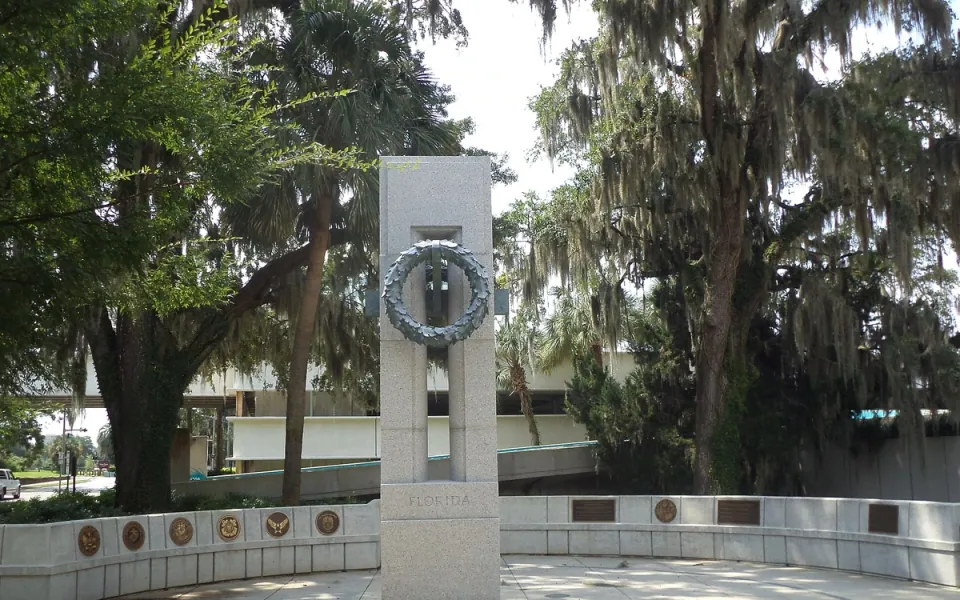
Photograph: Museum of Florida History - Florida World War II Memorial Monument.JPG by Michael Rivera · CC BY-SA 3.0 · Restored from the credited Wikimedia Commons file, normalized to the consistent attraction-card frame and converted to WebP by 1stFlorida.com. Portrait originals retain their complete composition over a softly blurred extension of the same photograph.
Leon County attraction
Leon County · Panhandle & Emerald Coast
The state history museum, in the R. A. Gray Building at 500 South Bronough Street in Tallahassee.
Also worth a visit
The old building was finished in 1845, the year Florida became a state. Frank Pierce Milburn enlarged it in 1902 and gave it the art glass dome and the red and white striped awnings it is known by.
It began in 1957 as the Tallahassee Junior Museum and moved to this site in 1962. The animals are Florida species in large naturalistic enclosures rather than cages: black bears, white-tailed deer, bobcats, red wolves and Florida panthers, the last two of them endangered.
It is a teaching museum, which shapes what goes on the walls. Exhibitions run to historical and contemporary art both, and a good part of the year is given over to showing the work of the university's own students and faculty, so the building changes completely from one visit to the next.
Hardy and Bryan Croom, tobacco planters from North Carolina, bought about twenty-four hundred acres here in 1834 and began a cotton and corn plantation worked by sixty enslaved people they brought with them. Arvah Hopkins, a New York merchant, took it over in 1857, ran it to eight thousand acres and held more than two hundred people in slavery on it.
DeVoe Moore opened it in May 1996 with fifteen vehicles and moved it into the present building, three times the size of the first one, in 2007. The cars run from a Snell of 1900 to a Camaro of 2010, and they are laid out as objects to look at rather than as a chronological lesson.
John Gilmore Riley was born into slavery in Leon County in 1857 and had no formal schooling; an aunt taught him. He began teaching in Wakulla County in 1877, worked with the local Board of Public Instruction from the 1880s until 1926, and was principal of Lincoln Academy from 1892 to 1926, the first secondary school in Tallahassee open to Black students.
Keep comparing