MUSEUM & CULTURE
Deering had the International Harvester fortune behind him and spent about fifteen million dollars of it here. F. Burrall Hoffman was the architect, Paul Chalfin the designer who chose and arranged almost everything inside, and Diego Suarez laid out the gardens.
MUSEUM & CULTURE
Herzog and de Meuron designed it and the building is an argument about how to put a museum in the subtropics. Two hundred thousand square feet of usable space sits across three stories on a raised platform, with a wide perforated canopy reaching out past the walls to throw shade over open-air terraces where people gather without going inside.
PARKS & OUTDOORS
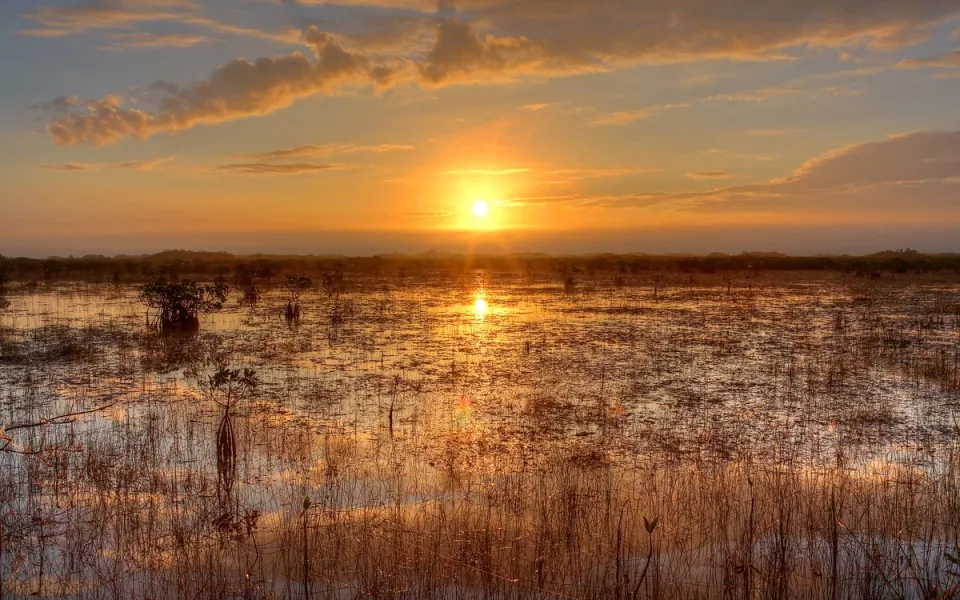
Four systems meet inside it and each depends on the next: the mangrove forest along the shoreline, the shallow water of Biscayne Bay, the northernmost Florida Keys, and the coral reef offshore. There is ten thousand years of human history in the park, from the people who lived on these keys before Europeans arrived, through the wrecks on the reef, to the houses on stilts at Stiltsville standing over open water.
GARDENS & LANDSCAPES
Robert H. Montgomery, an accountant who collected plants, founded it in 1936 and named it for his friend David Fairchild, the plant explorer who brought more than seventy-five thousand plants into the United States, mangoes and varieties of cotton and wheat among them. William Lyman Phillips laid out the grounds on principles of variety, consistency and contrast, using shade and changing path widths so that the garden reveals itself in stages rather than all at once.
WILDLIFE & CONSERVATION
It is the only tropical zoo in the continental United States, and that single fact shapes the collection: animals that would need heated houses further north live outdoors here all year. The exhibits are moated rather than caged, so the animals are seen across water and planting instead of through bars.
PARKS & OUTDOORS
It was established in 1967 and named for Bill Baggs, editor of The Miami News from 1957 until his death in 1969, who campaigned to keep this end of the key undeveloped. The Cape Florida Lighthouse stands in it and is the oldest standing structure in greater Miami.