Venetian Gardens
The islands are not natural. They were spoil piles in a marshy cove, built up in 1925 so that boats could dock there, and in 1936 men working for the Works Progress Administration planted the first ornamental beds on them.
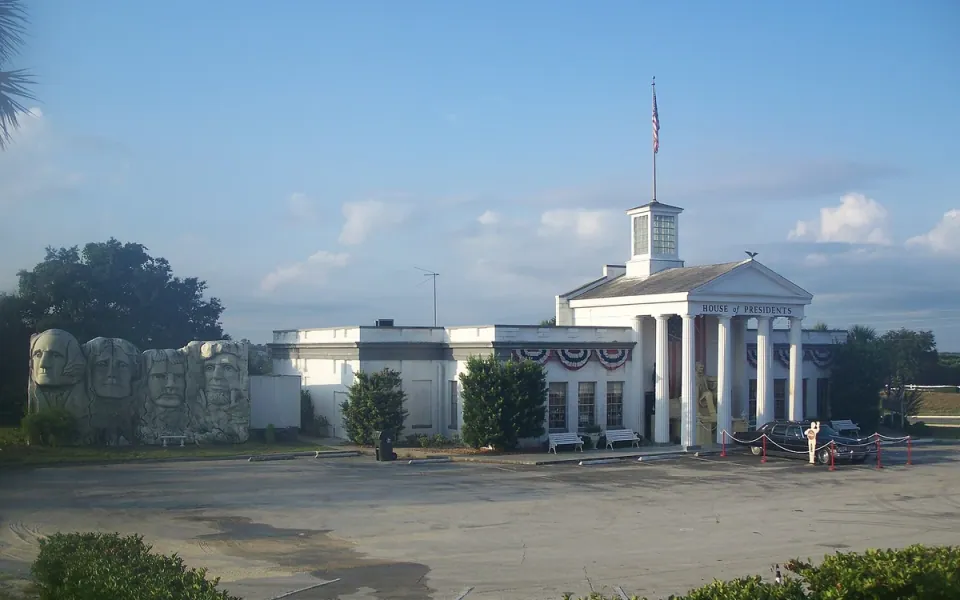
Photograph: Clermont PHOF01.jpg by Ebyabe · CC BY-SA 2.5 · Restored from the credited Wikimedia Commons file, normalized to the consistent attraction-card frame and converted to WebP by 1stFlorida.com. Portrait originals retain their complete composition over a softly blurred extension of the same photograph.
Lake County attraction
Lake County · Central Florida
A roadside museum of the American presidency in Clermont, beside the Citrus Tower.
Also worth a visit
The islands are not natural. They were spoil piles in a marshy cove, built up in 1925 so that boats could dock there, and in 1936 men working for the Works Progress Administration planted the first ornamental beds on them.
It opened in February 1989. What grows here is a mixture of native and imported: the muscadine varieties Noble, Carlos and Welder, which are the grapes that actually thrive in this climate, alongside Chardonnay, Pinot Grigio, Petite Sirah and Cabernet Sauvignon.
The drive opens Friday, Saturday, Sunday and federal holidays, from seven in the morning until three, with everyone out by five. The speed limit is ten miles an hour, vehicles over twenty-five feet and trailers are not allowed, and the whole thing takes one to three hours depending on how often you stop.
A. W. Thacker and F. J. Toole built it to show off the citrus industry, and it took five million pounds of concrete and 149,000 pounds of reinforcing steel. It stands on a hill 228 feet above sea level, so the spire reaches about five hundred feet above the sea, and in its early years half a million people a year rode the elevators up to look out over an unbroken sheet of orange groves in every direction.
The Antique Center sits on the south side: a building of forty thousand square feet, air conditioned, with more than 180 booths inside, consignment cases, and an outdoor Street of Shops. The Flea and Farmer's Market is on the north side, with over a hundred indoor booths, four hundred outdoor pavilion spaces and more open-air dealers beyond that.
It was a natural passage between the two lakes before it was widened, deepened and straightened in the late 1880s so that paddlewheel boats could carry freight through, a trade that lasted until the railroads arrived in the 1890s. What survived the dredging is the thing people come for: bald cypress hundreds of years old standing on both banks with their knees breaking the surface, the branches closing overhead so that the light comes down green.
Keep comparing