WATER & COAST
In 1949 this was set aside as the beach Black residents of Lee County were permitted to use, and for years it was the only one open to them. It carries the name of Ralph Bunche, the United Nations mediator who in 1950 became the first Black recipient of the Nobel Peace Prize.
PARKS & OUTDOORS
Nine miles of beach run down the Gulf side and almost none of it is built on. Behind the sand are pine flatwoods, oak palm hammock and mangrove swamp, and the island carries gopher tortoises, ospreys and a heavy passage of migrating birds in spring and fall.
PARKS & OUTDOORS
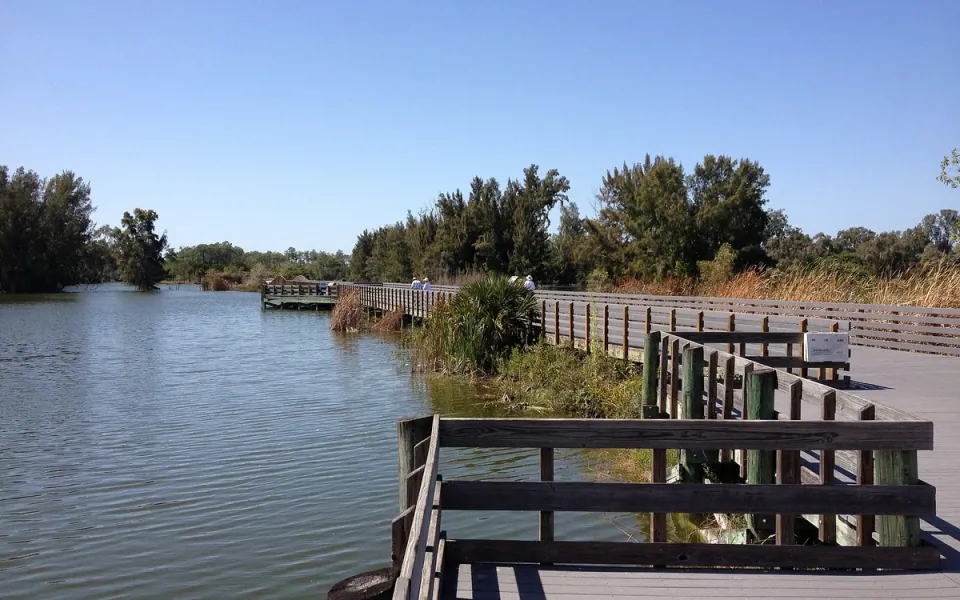
It is the second largest preserve in a city otherwise laid out almost entirely in canals and building lots, which is what makes it worth the detour. A loop of about a mile and a quarter runs partly on boardwalk through the mangrove fringe, with observation platforms and benches set where there is something to look at.
MUSEUM & CULTURE
Cape Coral did not exist before 1957, when the brothers Leonard and Jack Rosen and their Gulf American Land Corporation bought a peninsula of scrub and palmetto and began dredging canals and selling lots, much of it sight unseen to buyers in the north. The city was incorporated in 1970.
MUSEUM & CULTURE
It opened as the Imaginarium Science Center and was renamed in March 2017 when local history was added to what it covers, which is why the two subjects now sit side by side under one roof. The aquariums are the part children remember: the USS Mohawk tank, the lionfish tank, Fisheye Lagoon and touch tanks where rays and small sharks can be handled under supervision.
WATER & COAST
Sanibel lies east and west where almost every other barrier island on this coast lies north and south, and it sits on a shallow plateau reaching out into the Gulf. Those two facts together are why the shelling here is what it is: the island works like a scoop, and what the Gulf carries in piles up on the south beaches.