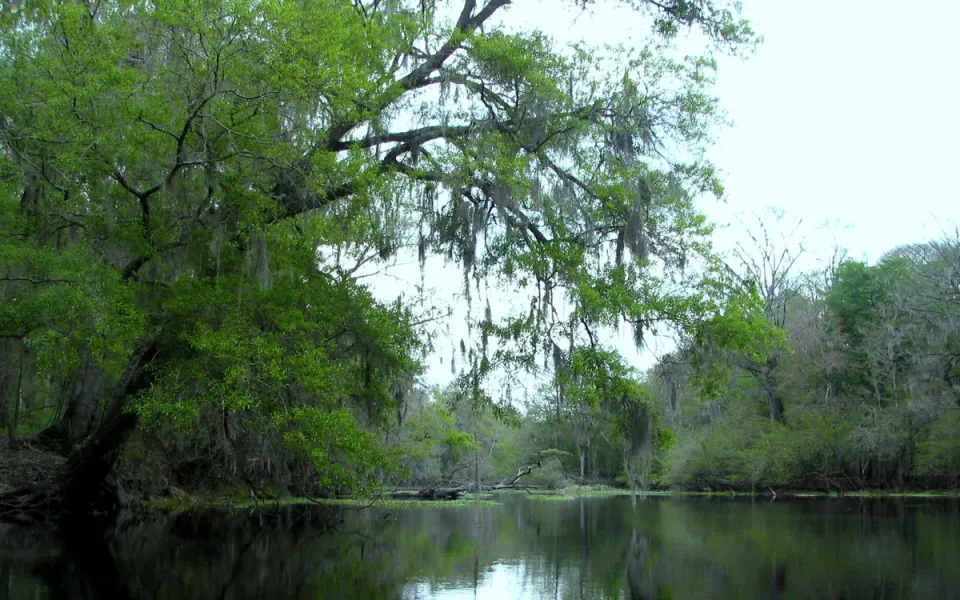
Photograph: Santa Fe River, near river rise, in Oleno State Park, Florida.jpg by Mwanner · CC BY-SA 3.0 · Restored from the credited Wikimedia Commons file, normalized to the consistent attraction-card frame and converted to WebP by 1stFlorida.com. Portrait originals retain their complete composition over a softly blurred extension of the same photograph.
Gilchrist County attraction
Santa Fe River
Gilchrist County · North Florida & First Coast
A 75-mile river that runs underground for three miles, then comes back up and collects a string of springs along the Gilchrist County line.
Ruth B. Kirby Gilchrist Blue Springs State Park sits at 7450 Northeast 60th Street in High Springs, on the Santa Fe River. Gilchrist Blue Spring itself is a sizable second-magnitude spring putting out 44 million gallons a day.
Hart Springs is a Gilchrist County park at 4240 Southwest 86th Avenue in Bell, on the Suwannee River Wilderness Trail and the Gilchrist Blueway. The county claims one of the largest spring-fed swimming areas in the state here, and the size is what people notice first: this is not a small pool but a broad open stretch of clear water.
Otter Springs Park and Campground is a Gilchrist County park at 6470 Southwest 80th Avenue, Trenton. A second-magnitude spring sits in the picnic area, and hiking trails and boardwalk run from the campground down to the Suwannee River.
The Suwannee rises in the Okefenokee National Wildlife Refuge near Fargo, Georgia, and runs about 246 miles southwest through south Georgia and north Florida to the Gulf. It forms the western edge of Gilchrist County, and every spring park in the county sits either on it or on the Santa Fe that feeds into it.
Ginnie Springs Outdoors is a privately run property in High Springs with seven springs on it and the Santa Fe River running through. The water holds 72 degrees the year round and is clear enough that swimmers can see the bottom from the surface.
Fort Fanning was built in 1838, during the Second Seminole War, on the north bluff over the Suwannee River at what is now Fanning Springs. The army put it there to hold an important river crossing and to work as a supply depot for operations along the Suwannee.