Dr. Julian G. Bruce St. George Island State Park
This park takes up the eastern end of St. George Island, about ten miles southeast of Eastpoint, reached by a four-mile bridge off U.S. 98. It was created in 1963 and is named for Dr. Julian G. Bruce.
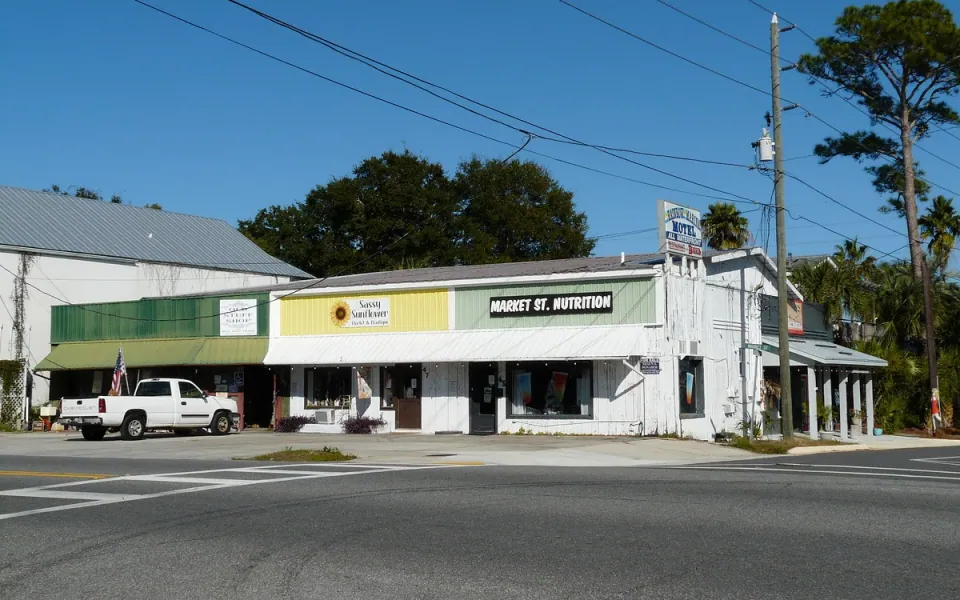
Photograph: Market Street Nutrition, Apalachicola, Florida.jpg by The Bushranger · CC BY-SA 4.0 · Restored from the credited Wikimedia Commons file, normalized to the consistent attraction-card frame and converted to WebP by 1stFlorida.com. Portrait originals retain their complete composition over a softly blurred extension of the same photograph.
Franklin County attraction
Franklin County · Panhandle & Emerald Coast
Six hundred and fifty-two historic buildings in a town that was once the third busiest port on the Gulf.
Also worth a visit
This park takes up the eastern end of St. George Island, about ten miles southeast of Eastpoint, reached by a four-mile bridge off U.S. 98. It was created in 1963 and is named for Dr. Julian G. Bruce.
The Apalachicola National Estuarine Research Reserve covers close to 250,000 acres of river, marsh and bay along what Florida calls the Forgotten Coast, taking in the lower 52 miles of the Apalachicola River and the estuary it feeds. UNESCO has designated it a Biosphere Reserve.
Tates Hell covers more than 202,000 acres, roughly 315 square miles, between Eastpoint, Sumatra and Carrabelle. The name comes from a story: in 1875 a man is said to have staggered out of the swamp and told the people who found him, my name is Cebe Tate, and I just came from Hell.
The Crooked River Lighthouse was built in 1895 to replace the Dog Island light, which a hurricane had destroyed in 1875. It guided timber ships and local fishing boats through the pass between Dog Island and St. George Island.
The first light here went up in 1833 near the west end of St. George Island, 65 feet tall, marking the way into Apalachicola Bay while the town was a cotton port. A second tower built in 1847 and 1848 was destroyed by a hurricane in 1851.
Thomas Orman built this house in Apalachicola in 1838. He was a cotton merchant, in business from 1834 into the 1880s, and his trade helped make the town one of the main cotton ports on the Gulf.
Keep comparing