Naples Botanical Garden
The organizing idea is a band of the earth. Everything grown here comes from the ecosystems lying between the 26th parallel north and the 26th parallel south, which is the latitude Naples itself sits on.
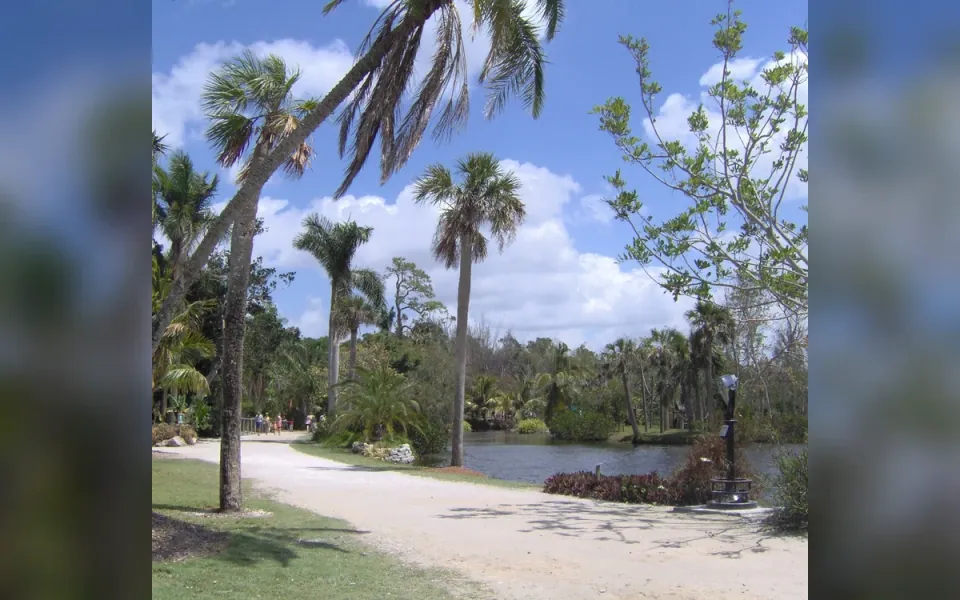
Photograph: Giraffes at naples zoo.jpg by Exupery67 · CC BY 4.0 · Cropped to the 1200x750 attraction-card frame and converted to WebP at quality 85 by 1stFlorida.com from the Wikimedia Commons original (3888x2421). Picked by David on November 1, 2026, opened and checked against the place before installation. Replaces a photo whose sides were a blurred copy of a tall original; that file is in _quarantine/blurred-places-replaced-2026-11-01, not deleted.
Collier County attraction
Collier County · South Florida & The Keys
Forty-three acres of zoo planted as a botanical garden in 1919, long before there were any animals in it.
Also worth a visit
The organizing idea is a band of the earth. Everything grown here comes from the ecosystems lying between the 26th parallel north and the 26th parallel south, which is the latitude Naples itself sits on.
A boardwalk two and a quarter miles long carries you through it without a foot touching the ground, and that boardwalk is the point of the place: the swamp stands in water for much of the year and there is no other honest way in. The National Audubon Society began building the first one in 1955, the year after the Corkscrew Cypress Rookery Association formed to buy the land and stop the loggers taking the last of the big trees.
Big Cypress and Big Thicket in Texas were designated the same year, creating a new category in the National Park System: land protected but still open to hunting, to off-road vehicles under permit, and to traditional use by the Miccosukee and the Seminole, who hold permanent rights to occupy and use it. It exists because of what was nearly built here.
NOAA designated it in 1980, first as a sanctuary and then almost at once as a research reserve, and the Florida Department of Environmental Protection's Coastal Office manages it together with NOAA. What it protects is one of the few undisturbed mangrove estuaries left in North America: a nearly untouched subtropical mangrove forest and the water running through it.
The name is made of two halves: the first three letters of Dellora and the first three of Norris, for Dellora A. Norris and Lester J. Norris, who helped buy the land in 1964. The park runs the length of the island with parking spaced down it, so the crowd spreads out instead of piling into one place.
The thing to see first here is a machine. The Bay City Walking Dredge stands in the park, a National Historic Mechanical Engineering Landmark, and it is the kind of dredge that built the Tamiami Trail across the Everglades: it walked itself forward on timber feet, digging the canal beside the road and using the spoil to raise the roadbed out of the water.
Keep comparing